Kleintheater Luzern: «All Inclusive»  – A Box for More

As people without a disability perspective, how can we contribute to making access to society and culture more inclusive? Kleintheater Luzern is working hard to find an answer. As a first step, the theatre’s co-management, inclusion officer and an inclusive working group have developed the «All Inclusive» toolbox. It supports individuals, groups and institutions from the spheres of culture, school and public administration on their path to greater inclusion. The toolbox helps jump-start efforts to break down barriers. Inclusion starts everywhere. «All Inclusive» is practical, light-hearted and result-focused.

Here is more information about the Kleintheater Luzern project «Inclusive cultural sector» and the documentary film «Alle inklusive – ein Kleintheater will mehr».

What does this tool consist of?

The physical toolbox consists of 3 parts.

  • No Taboo: a word game teaching inclusion terminology.
  • Workshop: a guide to help teams develop concrete measures.
  • Bits and Pieces: a website offering exercises, insights and important links on the topic of inclusion.


Who is this tool for?

«All Inclusive» is aimed at non-disabled individuals, groups and institutions from culture, schools or public administration.

Why is this tool needed?

«All Inclusive» poses key questions and invites us to answer them together:

  • What does inclusion mean in this context?
  • What knowledge is already available, what do we still need to learn?
  • What goals do we want to achieve and what challenges do we face in the process?
  • What motivates us to keep going and what support do we need?


What can this tool do?

«All Inclusive» makes people aware of barriers and empowers them to start breaking them down.

Tags

#inclusion
#culture
#inclusive
#society game
#workshop
#workshop
#theatre
#disability
#small theatreluzern
#barriers

Impressum

Kleintheater Luzern www.kleintheater.ch

Fabienne Mathis, Janine Bürkli

Publisher: Der gesunde Menschenversand GmbH, menschenversand.ch

«All Inclusive» was developed in collaboration with the Competence Centre for Diversity, Disability, and Inclusion (CCDI) at the University of St.Gallen amongst others. It has been tested by Theater Neumarkt Zurich, Theater Stadelhofen, the Lucerne Museums, Kunstmuseum Luzern and the ThiK Theater im Kornhaus Baden.
Documentary film on the transcontinental collaboration of GROUP50:50

In November 2023, the members of GROUP50:50 met in Berlin for a week to reflect on their collaboration and, in particular, on the process of creating the post-documentary musical theatre «The Ghosts are Returning». The group consists of artists from the Democratic Republic of the Congo, Switzerland and Germany. They thematise colonial crimes and neo-colonial mechanisms of exploitation in their work. Half of the positions are always filled by people from the DR Congo, the other half is made up of members from Germany or Switzerland.

What kind of tool is it?

The reflection process was documented in short interviews with the participants. These were edited into a ten-minute film that gives viewers an insight into the advantages and pitfalls of transcontinental cooperation. It also explores how the week of reflection unfolded. A central theme of the week of reflection was collaboration within an asymmetrical distribution of resources, which remains clearly apparent even when the group demographics (in this case, consisting of Congolese and European members) are balanced.

The short film, which consists of excerpts from the interviews, aims to encourage
other groups to address the entanglements between personal and structural conflicts that can occur in heterogeneous groups. Unravelling these misunderstandings, inequalities and injuries takes courage and time. By sharing their – sometimes very personal – insights, GROUP50:50 wishes to highlight that these negotiation processes are worth the effort.

Impressum

Authorship: GROUP50:50
Cinematography & editing: Franck Moka, Joseph Kasau,
Voiceover & surtitles: Luca Maier

GROUP50:50

Published 13.3.2026

art+care Newsletter – Visibility of current topics and activities of the community

The art+care newsletter is a collaborative publication format that brings visibility to topics, actors, and activities within the community. It is published monthly and serves as a curatorial tool for the network, bringing together discourses on care, art, and solidarity practices and offering different perspectives. This format provides a publicly accessible platform for networks, projects, and resources.

Most of the content shared in the newsletter comes from the multilingual Signal groups of the art+care community, where all chat members can contribute.

The tool shows that a newsletter can be used not only as an information channel but also as a participatory knowledge archive. Such a newsletter can support communities in continuously promoting visibility, exchange, and networking.

What does this tool consist of?

Updates on art+care activities and current contributions from the entire community (called art+care Cosmos)

Why is this tool needed?

Strengthening the care discourse and interdisciplinary exchange in art and culture

What can this tool do?

Creating visibility and knowledge transfer

Who is this tool for?

A newsletter for anyone interested in contributions and formats related to the topic of art and care work

Concept & editing:
art+care core team

Content:
Contributions from members of the Signal groups (art+care Cosmos)

Contact:
contact@artandcare.org

Website:
artandcare.org

Newsletter registration

Signal Group (art+care Cosmos)

Published 05.03.2026

A:Practice

Action Matrix – Turning Cultural Institutions into Ecological Players

A:Practice enables a global perspective on the planet’s ecological situation and defines four fields of action that can help to restore balance.

The tool was developed in collaboration with The Forgotten Angle Theatre Collaborative (FATC), South Africa, and KlimaKontor Basel, Switzerland.

What does this tool comprise?

A:Practice is centred around its “matrix of action”. This matrix provides guidance; it facilitates immediate action and the simultaneous implementation of various sustainability concepts. It is compatible with other approaches to organisational development.

Why is this tool important?

We see that ecological crises continue to escalate while social upheaval is on the rise. At the same time, we see the great potential of cultural institutions to contribute to a society that thinks and acts ecologically. We meet people in charge of institutions who feel the need to move from knowledge to action.

Tags

#climatepositive
#solidarity
#south africa
#global perspective
#collaboration
#responsibility
#action
#transformation
#ecological narrative
#joy

What does this tool do?

The A:Practice Matrix of Action

  • supports the development of institutional ecological competences
  • empowers the organisation to take action in line with its specific location, resources and qualifications
  • facilitates immediate action across all levels of the organisation
  • invites all members of the organisation to contribute in line with their skills, motivation and personal interests
  • makes it possible to implement multiple measures simultaneously
  • reduces bureaucracy
  • promotes trans-institutional networking
  • provides a dramaturgical framework for ecological narratives

Who can use this tool?

A:Practice can be used by any individual, group, company, etc. Above all, it is intended for those who work in cultural institutions. It is also aimed at the people in charge of these institutions’ positioning and content: artistic directors, directors, management teams, authors, dramaturges, artists, curators, mediators, etc.

Impressum

The Forgotten Angle Theatre Collaborative (FATC), est. 1995

KlimaKontor Basel, est. 2020

Barbara Ellenberger (A:Practice Switzerland)
Matthias Michel (A:Practice Switzerland)
Peter John Sabbagha (A:Practice South Africa)

produktionsDOCK: Guide – Producing in the Swiss independent performing art scene

This guide provides practical orientation for artists and production managers in the independent performing arts scene of German-speaking Switzerland. Step by step, it guides you through the central phases of an artistic project – from the initial idea to its concrete realisation, distribution and touring. The focus is on practical information and realistic insights into the typical process of a production as it is realised in collaboration with established event organisers in German-speaking Switzerland.

What does the tool consist of?

The content is based on the current work experiences of the production managers of produktionsDOCK, a Basel office of production managers (2017-2024), and reflects practice in 2024. This guide is intended as a snapshot that offers a comprehensive insight into the working methods of the Swiss independent performing art scene, without any general claim to completeness or binding force.

It is divided into three main chapters that accompany the phases of an artistic project in a structured and practical way: conception, production, diffusion/touring.

In addition, two detailed discussions provide in-depth insights into the topics of personnel and association administration, which are important for successful project work.

Tags

#productionmanagement
#projectadministration
#productioncycle
#management
#helpforself-help
#freescene
#performingarts
#freeproducing

Who is this tool aimed at?

The guide is aimed at anyone who is active in the independent scene in German-speaking Switzerland or would like to establish themselves there: young artists and production managers who are gaining their first experience but also experienced producers who are looking for inspiration or a useful tool for promoting young talent.

Impressum

Publisher: produktionsDOCK

Editors: Annina Birrer, Bernhard la Dous, Regula Schelling, Juliana Simonetti, Salomé Rodríguez Bär

Design: Céline Müller
Proofreading: Heike Dürscheid

The realisation of the guide was made possible by the generous support of m2act, the funding and network project of the Migros Culture Percentage for the performing arts, the Christoph Merian Foundation and the Ernst Göhner Foundation.


Artists Take Action

This guide supports cultural workers from all disciplines with questions about social security.

With this comprehensive knowledge database, Artists Take Action provides information on important topics such as retirement, family, stays abroad, accidents, and illnesses. It also explains which insurances are mandatory and which are optional. Regardless of how much you already know about social security, this guide—created by cultural workers for cultural workers—answers the most pressing questions.

Due to the legal content, the Artist Take Action guide is in German, French and Italian.

Who is this tool for?

Artists Take Action is aimed at all cultural workers who live and work in Switzerland.


What does this tool consist of?

Artists Take Action is the most comprehensive cross-disciplinary guide to social security in the cultural sector. It provides answers to specific questions about social insurance and forms of employment. For further inquiries, it facilitates contact with the respective professional association.

Why is this tool needed?

Many cultural workers receive little to no education about the basic principles of the labor market during their training. Artists Take Action helps to fill fundamental gaps regarding labor law, self-employment, social security, and insurance.

Impressum

Suisseculture Sociale

info@suisseculturesociale.ch

artists-take-action.ch

Perma-curatorial seeds: A series of workshops by the far° festival and factory of living arts 

The video «Planting perma-curatorial» – a series of workshops as part of the PERMA-CULTURE project – documents a participatory workshop where the principles of permaculture are experimentally applied to a cultural context, particularly to the performing arts. The experts in this field are: the far° Nyon team, Leila Chakroun, and Gregory Stauffer.

Drawing on collective intelligence and creativity, these multi-disciplinary workshops are designed to deploy in different contexts of the publication PERMA-CULTURE (work in progress). The first cycle of far° research aims to make the living arts «more alive». This series of workshops organised across Switzerland is an opportunity to exchange practices and theoretical knowledge and to learn from each other about concrete solutions.

What does this tool consist of?

This is a video tool. It offers an accessible approach to the PERMA-CULTURE concept presented by far° Nyon and its partners. It provides a visual and audio illustration of the work involved in pooling knowledge in order to share experiences within the performing arts. This tool is designed for all arts professionals.


Contact person

Anne-Christine Liske
liske@far-nyon.ch
+41 22 365 15 59

Impressum

A video by Matthieu Moerlen, Mr Jadis Production

With far° Nyon, Leila Chakroun and Gregory Stauffer

English subtitles by Alexandre Cracker

Supported by Migros Culture Percentage m2act, the City of Nyon, the Canton of Vaud and the Region of Nyon


FemaleAct Calculator

FemaleAct is an association of FINTA actors who live and work in Switzerland (FINTA stands for Women (Frauen), Intersex, Non-binary, Trans and Agender individuals). They use their professional experience to identify where structural change is needed in the performing arts and develop projects to accelerate it.

FemaleAct has developed the online tool «Kalkulator» over the last two years. It has been integrated in the FemaleAct website since December 2023. In 2024, the tool will be further developed in collaboration with the first users.

What does this tool comprise?

On the FemaleAct website, performing artists can quickly and easily calculate care costs outside regular working hours (7:00am-6:00pm).

The first version of the calculator focuses on childcare.

Tags

#care
#costs
#fair wages
#fair practice
#contracts

What does this tool do?

The calculator works out the childcare costs you will have to bear during rehearsals over and above the institutional options. The result can be downloaded as a PDF.

So you can:

  • enter into wage negotiations
  • contribute to a fair wage structure
  • raise awareness of work-life balance

Who is this tool for?

The FemaleAct calculator is available free of charge to both artists and employers.

Why is this tool important?

In performing arts projects (theatre, performance, film, etc.), work is often done outside regular working and institutional childcare hours. Artists therefore often incur additional childcare costs, which they have to bear privately.

The calculator helps to make these costs visible, enabling the additional care work to be adequately factored into cultural project budgets.

Impressum

FemaleAct association: femaleact.ch

Facebook

Instagram

Illustration: Rachel Duc

Dampfzentrale Bern: Salary scheme for fair wages at cultural institutions in Switzerland

Dampfzentrale Bern commissioned the Centre for Cultural Management ZHAW to conduct the «Vorstudie Löhne Freie Kulturszene Schweiz» (Preliminary Study on Wages in the Independent Cultural Scene in Switzerland). Based on this, it has developed a scheme for fair standard wages for permanent employees at independent production houses in Switzerland.

This fair pay table is based on the Austrian model, «Fair Pay für Kulturarbeit». To date, no standardised guideline wages nor recommendations exist for employees in production, communication, management and technology at cultural institutions in Switzerland. The tpunkt professional association’s standard fees primarily affect freelancers.

ZHAW’s preliminary study provides an inventory of the current wage situation at independent production houses (focus: guest venues for dance and theatre). The results can also be transferred to cultural centres focusing on other genres.

A salary scheme was created on this basis, enabling cultural institutions to commit to transparent, fair wages. Every cultural institution’s core business is the presentation, discussion and communication of artistic creation. The salary scheme is based on the idea that commercial and artistic professions should be given equal weighting at similar levels of responsibility. 

The study was conducted in German, therefore all documents are in German.

Why is this tool necessary?

The salaries of permanent employees at Swiss cultural institutions are well below average when compared with similar positions in other sectors. This exacerbates the shortage of skilled personnel, weakens social sustainability and negatively impacts the qualitative consistency of work performed at institutions. To date, there are no standardised guideline wages and recommendations for employees in production, communication, management and technology at cultural institutions in Switzerland. The standard fees of the professional association tpunkt and the endeavours as part of the 2025–2028 cultural message primarily concern freelancers.

What this tool do?

The new salary scheme offers an easy-to-use, transferable, transparent modular system for application to all positions in a cultural institution.

Who is this tool for?

Cultural institutions in Switzerland that want to commit to fair, transparent salaries.

Focus: guest venues for dance and/or theatre


What does this tool consist of?

Its central element is a modular system that can be used for all positions in a cultural institution.  The basis for this was provided by the results of ZHAW’s preliminary study.

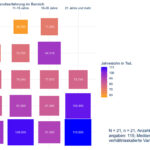
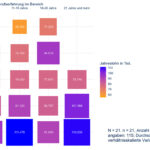
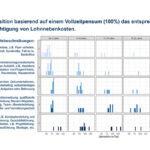
Information on wages in the cultural organisations (all values)

Information on wages in the cultural organisations (median)

Information on wages in the cultural organisations (average)

Impressum

Dampfzentrale Bern

Karin Bitterli (Commercial Director Dampfzentrale Bern), bitterli@dampfzentrale.chThe

FIT FOR THE FUTURE: 2025 Annual Report

This Annual Report provides an overview of the first year of FIT FOR THE FUTURE, a three-year project created as part of the FIT Festival. The report covers a process of observation, learning and transformation related to transitions in artistic leadership, outlining often undocumented dynamics, such as relationships, fragilities, responsibility and tacit knowledge. The report also includes a provisional set of principles for transitions in artistic leadership based on experience gained during the first year, providing a tool kit for reflection and guidance. The report does not set out conclusive results, but a work-in-progress pathway towards creating a sustainable and replicable transition model in the performing arts sector.

It reports on the first of three years. Another report will be produced for the year 2026. A third report, scheduled for the end of 2027, will present the entire process as a model project and will be available in all languages.

What does this tool consist of?

It reports on a process documenting the first year of a transition in artistic leadership, outlining reflections, practices and operational principles.

What can this tool do?

It provides guidance, language and key tools to support more gradual and sustainable transitions based on greater awareness.

Who is this tool for?

Artistic directors, cultural teams and institutions facing or considering a change of leadership.

Why is this tool necessary?

To highlight and share what is usually informal and undocumented knowledge, the lack of which often results in traumatic transitions.


Impressum

Paola Tripoli and Simon Waldvogel

produzione@fitfestival.ch

www.fitfestival.ch