From thread to needle – building sustainable governance

This video follows the strategic retreat conducted by Costumières & Cie in 2025 with the support of Migros Culture Percentage m2act. It documents a key moment of collective reflection in which the board reviewed how the association operates and contemplated its values and future needs. This video provides a testimony of this crucial moment for the organisation and a way of sharing it with the public.

What does this tool consist of?

This tool is a documentary video showing what happened before and after the retreat in the words of those involved. It outlines the collective process that led to the drawing-up of Costumières & Cie’s charter and working conditions

What’s the purpose of this tool?

The processes of collective reflection, governance and organisational transformation are rarely captured. This video reveals how a brief but intensive period of time can have a profoundly transformative impact on a group if properly supported. It shows how – in a cohesive environment where people listen to each other – unexpected collective collaboration can be achieved – at both human and structural level.

What can this tool do?

The video allows its audience to share in a real-life experience of group work, inspires other associations or cultural groups and puts the tools produced by Costumières & Cie in context. It helps people understand the human, political and professional issues involved in the cultural sector.

Whom is this tool designed for?

This tool is aimed at Costumières & Cie members, cultural associations, institutions, partners, funding providers and anyone interested in issues related to collective governance, working conditions and structural organisation in the arts sector.

Additional toolbox by Costumières & Cie

Working conditions for the costume industry

Impressum

Film director: Erika Irmler
Costumières & Cie – video produced as part of the retreat in 2025 supported by the Migros Culture Percentage’s m2act

Contact: info@costumieres-et-cie.ch

www.costumieres-et-cie.ch


Published 19.03.2026
Documentary film on the transcontinental collaboration of GROUP50:50

In November 2023, the members of GROUP50:50 met in Berlin for a week to reflect on their collaboration and, in particular, on the process of creating the post-documentary musical theatre «The Ghosts are Returning». The group consists of artists from the Democratic Republic of the Congo, Switzerland and Germany. They thematise colonial crimes and neo-colonial mechanisms of exploitation in their work. Half of the positions are always filled by people from the DR Congo, the other half is made up of members from Germany or Switzerland.

What kind of tool is it?

The reflection process was documented in short interviews with the participants. These were edited into a ten-minute film that gives viewers an insight into the advantages and pitfalls of transcontinental cooperation. It also explores how the week of reflection unfolded. A central theme of the week of reflection was collaboration within an asymmetrical distribution of resources, which remains clearly apparent even when the group demographics (in this case, consisting of Congolese and European members) are balanced.

The short film, which consists of excerpts from the interviews, aims to encourage
other groups to address the entanglements between personal and structural conflicts that can occur in heterogeneous groups. Unravelling these misunderstandings, inequalities and injuries takes courage and time. By sharing their – sometimes very personal – insights, GROUP50:50 wishes to highlight that these negotiation processes are worth the effort.

Impressum

Authorship: GROUP50:50
Cinematography & editing: Franck Moka, Joseph Kasau,
Voiceover & surtitles: Luca Maier

GROUP50:50

Published 13.3.2026

Dampfzentrale Bern: Salary scheme for fair wages at cultural institutions in Switzerland

Dampfzentrale Bern commissioned the Centre for Cultural Management ZHAW to conduct the «Vorstudie Löhne Freie Kulturszene Schweiz» (Preliminary Study on Wages in the Independent Cultural Scene in Switzerland). Based on this, it has developed a scheme for fair standard wages for permanent employees at independent production houses in Switzerland.

This fair pay table is based on the Austrian model, «Fair Pay für Kulturarbeit». To date, no standardised guideline wages nor recommendations exist for employees in production, communication, management and technology at cultural institutions in Switzerland. The tpunkt professional association’s standard fees primarily affect freelancers.

ZHAW’s preliminary study provides an inventory of the current wage situation at independent production houses (focus: guest venues for dance and theatre). The results can also be transferred to cultural centres focusing on other genres.

A salary scheme was created on this basis, enabling cultural institutions to commit to transparent, fair wages. Every cultural institution’s core business is the presentation, discussion and communication of artistic creation. The salary scheme is based on the idea that commercial and artistic professions should be given equal weighting at similar levels of responsibility. 

The study was conducted in German, therefore all documents are in German.

Why is this tool necessary?

The salaries of permanent employees at Swiss cultural institutions are well below average when compared with similar positions in other sectors. This exacerbates the shortage of skilled personnel, weakens social sustainability and negatively impacts the qualitative consistency of work performed at institutions. To date, there are no standardised guideline wages and recommendations for employees in production, communication, management and technology at cultural institutions in Switzerland. The standard fees of the professional association tpunkt and the endeavours as part of the 2025–2028 cultural message primarily concern freelancers.

What this tool do?

The new salary scheme offers an easy-to-use, transferable, transparent modular system for application to all positions in a cultural institution.

Who is this tool for?

Cultural institutions in Switzerland that want to commit to fair, transparent salaries.

Focus: guest venues for dance and/or theatre


What does this tool consist of?

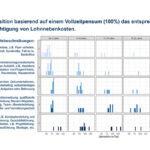
Its central element is a modular system that can be used for all positions in a cultural institution.  The basis for this was provided by the results of ZHAW’s preliminary study.

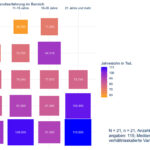
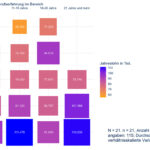
Information on wages in the cultural organisations (all values)

Information on wages in the cultural organisations (median)

Information on wages in the cultural organisations (average)

Impressum

Dampfzentrale Bern

Karin Bitterli (Commercial Director Dampfzentrale Bern), bitterli@dampfzentrale.chThe

FIT FOR THE FUTURE: 2025 Annual Report

This Annual Report provides an overview of the first year of FIT FOR THE FUTURE, a three-year project created as part of the FIT Festival. The report covers a process of observation, learning and transformation related to transitions in artistic leadership, outlining often undocumented dynamics, such as relationships, fragilities, responsibility and tacit knowledge. The report also includes a provisional set of principles for transitions in artistic leadership based on experience gained during the first year, providing a tool kit for reflection and guidance. The report does not set out conclusive results, but a work-in-progress pathway towards creating a sustainable and replicable transition model in the performing arts sector.

It reports on the first of three years. Another report will be produced for the year 2026. A third report, scheduled for the end of 2027, will present the entire process as a model project and will be available in all languages.

What does this tool consist of?

It reports on a process documenting the first year of a transition in artistic leadership, outlining reflections, practices and operational principles.

What can this tool do?

It provides guidance, language and key tools to support more gradual and sustainable transitions based on greater awareness.

Who is this tool for?

Artistic directors, cultural teams and institutions facing or considering a change of leadership.

Why is this tool necessary?

To highlight and share what is usually informal and undocumented knowledge, the lack of which often results in traumatic transitions.


Impressum

Paola Tripoli and Simon Waldvogel

produzione@fitfestival.ch

www.fitfestival.ch

Sustainable Impact Tool

The Sustainable Impact Tool is a free working tool for cultural institutions and projects in Switzerland. It supports general and creative artists in systematically analysing their activities with regard to ecological and social sustainability. The effectiveness of sustainable action can thus be tested both at the institutional level and for individual productions, tours or events. The tool is refined on an ongoing basis.

What does this tool consist of?

The Sustainable Impact Tool enables the simplification of sustainability reporting through a variety of digital modules. Sub-elements enable the clear calculation of the CO2 footprint and further reporting modules for various areas of social sustainability are continually added.


Tags

#responsibility
#action
#sustainability
#reporting

What can this tool do?

The Sustainable Impact Tool supports an easily accessible and systematic analysis of the activities of general and creative artists with regard to environmental and social sustainability.

Who is this tool for?

The Sustainable Impact Tool is available free of charge for use by all cultural institutions, events, productions and tours in Switzerland. 

Why is this tool needed?

Simple reporting enables the prioritisation of measures based on their effectiveness for sustainable development. This makes it possible to monitor impact and deploy resources where they can have the greatest effect.


Impressum

The tool was launched by Pro Helvetia and the Migros Culture Percentage.

Les bonnes pratiques

A self-assessment tool and concrete ways of promoting sustainability in the performing arts

Les Bonnes Pratiques is a joint pilot project of the Association des Compagnies Vaudoises and the Syndicat Suisse Romand du Spectacle. This initiative is primarily aimed at project managers in the performing arts. Through a non-binding self-assessment process, Les Bonnes Pratiques raises awareness of the issues surrounding working conditions and sustainability within professional practice in the cultural sector.

What does the tool consist of?

The tool is provided in the form of an internet platform. It consists of:

  • a guide
  • resources
  • a self-assessment tool

It can be used partially or fully, depending on the user’s wishes.

Tags

#lesbonnespratiquesch
#selfevaluation
#health in the workplace #sustainable art

What can this tool do?

By taking the time to scrutinise your project with the help of Les Bonnes Pratiques, you can identify possible weaknesses and act accordingly in a well-founded and persuasive manner. This is the first step towards significant improvements in the process of setting up and implementing projects.

Why is this tool needed?

In addition to the ecological aspects that all cultural professionals urgently need to consider when designing their projects, it also addresses issues surrounding the working environment. These are especially important, as the situation for employees in the independent cultural sector gradually deteriorates.

Who is this tool aimed at?

Les Bonnes Pratiques is primarily aimed at project managers in the performing arts. However, the concrete opportunities highlighted by the tool can inspire anyone who wishes to incorporate sustainability into their working practices.